by Neetu | May 28, 2020 | Fitness Activity
Movement skills/concepts
Dodging, space awareness, and changing speed.
Set-up
Children are spread out in a defined grass or hard surface area.
Activity
Who can dodge …? (or Can you dodge …?)
- from a high/low level, high to a low level, low to a high level
- indifferent directions, sideways, left/right, backwards/forwards
- as quickly/slowly as you can, with alternating fast and slow dodges
- smoothly/roughly
- keeping at a medium level
- with a great force
Variations
Add start and stop signals: On the signal ‘Go’, children run in any direction; when a whistle (or any other signal) is called, children stop as quickly as they can.
Travel around stationary objects: Include objects to dodge (e.g. cones, chairs, balls, ropes, hoops – consider safety in your choices). Children travel as quickly as they can through the general space while avoiding objects and others.
Travel in different pathways: On a signal, children move only in a curved or straight pathway. On a whistle (or any other signal), change to a different pathway
(e.g. circle, figure 8, zigzag).
by Neetu | May 28, 2020 | Fitness Activity
Movement skills/concepts
Dodging, swerving, evading, and throwing at a moving target.
Set-up
Large, softballs.
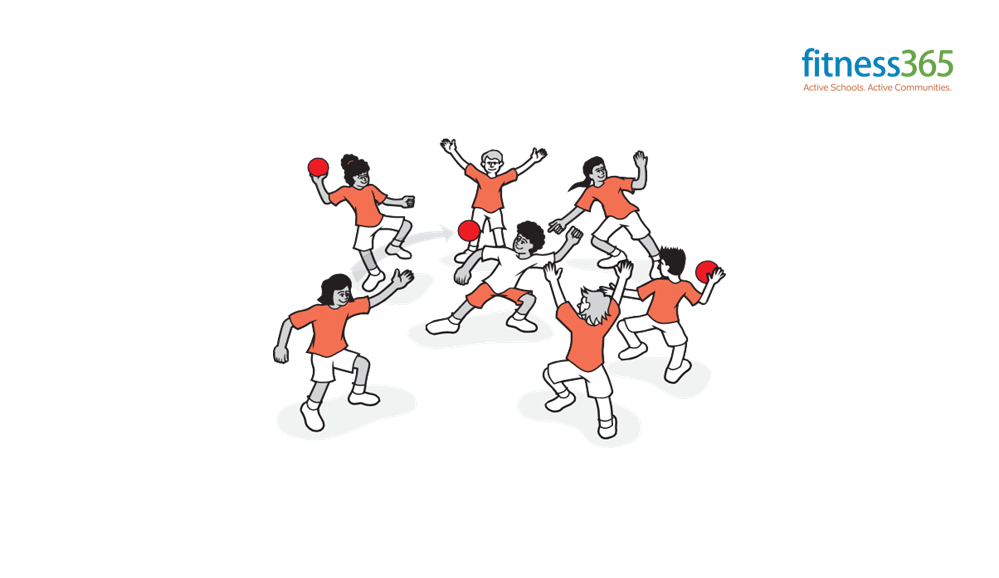
Groups of six-seven: a dodger stands in the center of a marked circle, the others are throwers standing around the outside of the circle in the grass or hard surface area.
Activity
The dodger tries to keep away from the ball. The throwers try to hit the dodger below the knees. They can pass anywhere to catch the dodger off guard. Each person has a turn as the dodger.
- Throwers: passing fast to keep the dodger swerving and turning
- Dodger: using quick feet with quick reactions
Variations
Increase the number of dodgers: Include two or three dodgers in the middle of the circle.
Vary area of a circle: Increase or decrease the circle size.
by Neetu | May 28, 2020 | Fitness Activity
Aim
Move safely in self-space, today we are going to play Beanbag Bandage. In this game, the Patient was injured while and the doctors need to figure out where to put the bandage.
.Equipment Required
- Four cones for boundaries (same color
- Spot marker for every kid.
- 1 bean bag per student & 1 small cone for 5-6 students
Play Area Set-Up
- Send groups of 5 or 6 students to a cone, each student should have a beanbag.
- One student acts as the Patient and stands next to the cone. The other students are Doctors and form an arc around the Patient.
Activity Description
- It’s time to play Beanbag Bandage. The Patient was injured while playing and the doctors need to figure out where to put the bandage.
- Altogether, the doctors will ask, “Where does it hurt?” The Patient picks a body part to call out and places the beanbag over the injury. For example, “My elbow hurts!”
- All of the doctors follow along by also placing beanbags on their elbows and saying, “All bandaged up! Is that better?” The patient says, “Yes, thank you!”
- The doctors ask again, “Where does it hurt?” The Patient says another body part, “My toes hurt!” This continues until the teacher stops play and chooses new Patients.
KEY TEACHING POINTS – Respond to the instructions after listening carefully.
by Neetu | May 28, 2020 | Fitness Activity
Aim
How to find personal space with the help of a bubble.
Equipment Required
- Four cones for boundaries (same color)
- Spot marker for every kid
- Skill Cards of direction
Play Area Set-Up
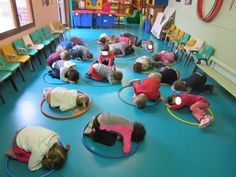
Make circle markings on the floor and ask children to sit with their hands on their knees with their eyes looking at you (crisscross-apple-sauce).
- Explain any special safety rules for the day.
- Explain that when you give a specific signal (e.g. whistle blow), the children must Stop/Freeze, Look, and Listen.
Activity Description
- Greet the children, introduce yourself, and bring them to the center.
- Ask the children to hold hands and form a circle with you, then sit down Explain in 20-30 seconds what you will be doing today and start the first activity.
Define “Personal Space”: is all the space that the body or its parts can reach without traveling away from a starting location
Activity: Making shapes (6 – 8 minutes)
- Explain that the children will now make shapes with their bodies within their space bubble.
- Demonstrate that the space bubble gets bigger or smaller depending on the size of the shape.
- Ask the children to imitate you as you make the following shapes:
- Star (arms and legs stretched wide, standing or lying down)
- Ball (crouch and tuck as small as possible)
- Candle (stand straight and tall with arms above head)
- Flamingo (stand on one leg with arms out to sides)
- Give the children an opportunity to invent their own shapes.
If time permits, ask a few students to demonstrate their shapes and ask the rest to imitate
Teaching Tips – From time to time, ask the children to freeze, check that they are maintaining their space bubbles.
by Neetu | May 28, 2020 | Fitness Activity
Aim
Perform each fitness challenge accurately
Equipment Required
- Four cones for boundaries (same color).
- Spot marker as per need.
- 6 hula-hoops
- 6 Fitness Station Cards
- 1 Health-Related Fitness Challenge Card per group
- 4-6 exercise bands
Play Area Set-Up
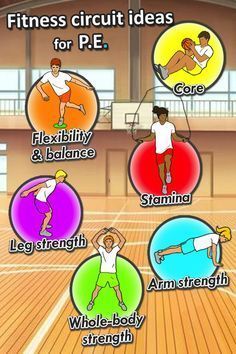
- Create a large circle or grid with hula-hoops identifying each station. Number stations 1-6 using Fitness Station Cards.
- Place station cards and pencils inside hoops.
- Create groups of 4-6 students. Send each group to a different station to begin the rotation
Activity Description
- Today we’re going to complete a series of Health-Related Fitness Challenges by working in stations and then rotating after 3 minutes.
- Look at the station number where you’re starting. Be sure to start with the same number on your challenge card (teachers provide an example). Write down how many repetitions of each exercise or challenge you complete.
- I will be at Station 6 helping with your individual assessment
KEY TEACHING POINTS – On signal reset the station equipment and rotate to the next
Grade Level Progression
- Provide detailed instruction for each station and post discussion questions at Station 12. This will allow you to circulate and supervise all stations.
- Provide a brief overview of each station and observe student performance as an assessment of reading and content comprehension.
- Give students 1-minute to read and review the challenge card, then check for understanding.