by Neetu | Jun 1, 2020 | Fitness Activity
Movement skills/concepts
Locomotor skill (crab walking), kicking, and relationships (with others).
Set-up
- Marker cones (goals), large light ball (foam, rubber, or plastic).
- Large defined hard or grass space with marker cones at each end and the ball midway between the goal lines.
- Two teams of approximately eight-ten players each.
Activity
Each team sits on its goal line facing the other team, with arms extended backward supporting the body from the ground (crab position). Maintaining the crab position, both teams advance towards the ball in the middle and attempt to kick the ball over the opposing goal line.
Rules:
- players can kick the ball with one foot or drop and kick it with both feet
- they cannot stand up or touch the ball with their hands
Variations
Three-legged soccer: Within each team, pairs have their inside legs tied with a scarf or band and attempt to score by kicking a goal.
by Neetu | Jun 1, 2020 | Fitness Activity
Movement skills/concepts
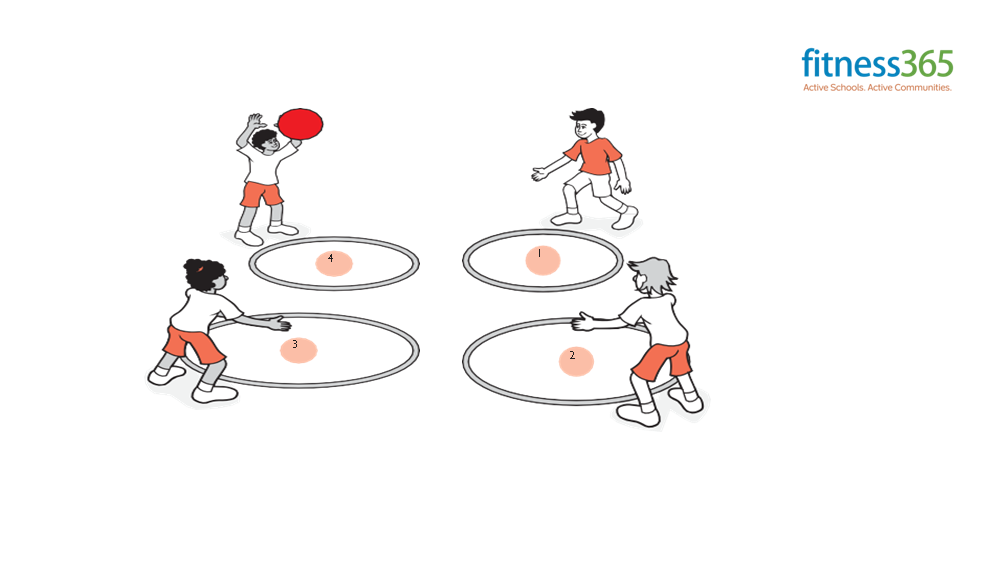
Throwing a ball at a stationary target and receiving a bouncing ball. The aim is to progress to and stay in circle 4.
Set-up
- Large balls that bounce, hoops or circles drawn on the ground (chalk, spray-paint) 1 meter in diameter.
- The hard surface area on which four hoops/circles are arranged 4 meters apart – adjust distance according to ability.
- Groups of approximately four–five, with one ball per group: one player stands behind each circle/hoop.
Activity
The server stands behind circle 4 and throws the ball to bounce into any other circle. The player covering that circle must catch the ball after the first bounce, then throw it to another circle. The game continues until a player throws the ball outside a circle or drops the ball and is out. When out, the player moves to the waiting line. Incoming players go to circle 1, and others rotate to fill the gap.
Rules:
- on the line is in
- one step in any direction is allowed from where the ball is caught
- the ball must bounce above knee height
Variations
Modify rules: The ball must bounce above head height. The last player in the waiting line may act as an umpire.
Vary equipment and skills: Strike with the hand(s), kick, or strike with an implement.

by Neetu | Jun 1, 2020 | Fitness Activity
Movement skills/concepts
Striking a ball with an implement, underarm throw for accuracy, overarm throw for accuracy, fielding a small ball, and running.
Set-up
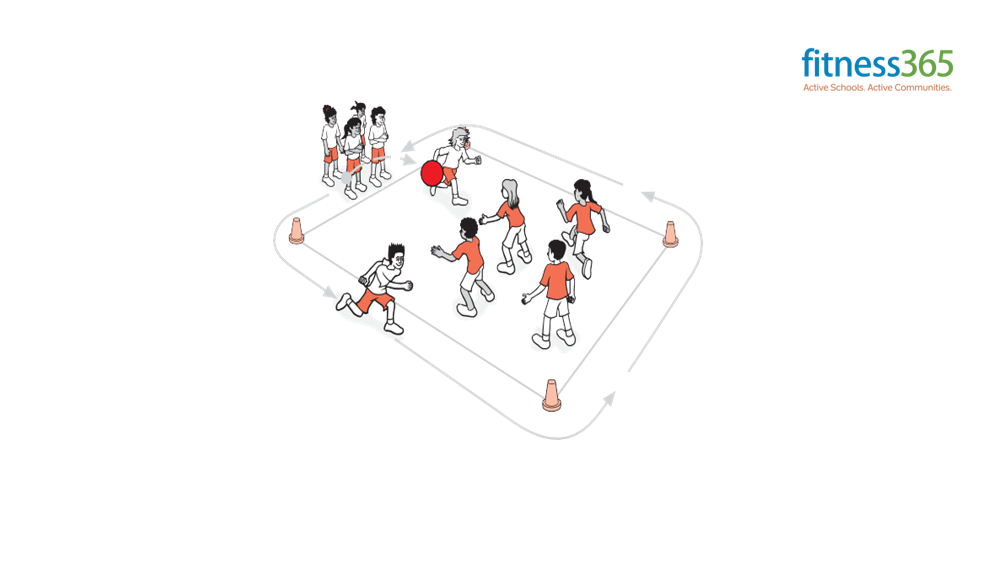
One small ball, one short implement (bat/racquet), six markers, and team bands/bibs. Two teams of approximately six-eight players each: the batting team is lined up safely back from the baseline, and the fielding team is scattered out in the field of play, with one member as a pitcher.
Activity
The pitcher lobs to the batter, who attempts to hit the ball. The batter then tries to score a run by running to the far line and back. They may wait as long as they like behind the far line for a chance to return. The fielders try to put the other team out by tagging a batter with the ball while they are running. A fielder may throw the ball to another fielder nearer to the batter in an attempt to do this.
The batting team is out if:
- a running batter is hit with the ball
- a fielder catches a hit on the full
- a batter hits the ball over the sidelines on the full or so that it bounces out before it reaches halfway up the field of play
- a running batter goes over either of the sidelines
When there is an ‘out’, the umpire calls (or signals) ‘Change’ and the teams change over but, if a member of the team that has just finished batting can retrieve the ball and tag a player from the other team before they are safely behind the baseline or far line, the old batting team is ‘in’ again. This can happen several times.
Other rules:
- fielders may not hold the ball for more than 3 seconds
- once a waiting runner puts a foot into the field of play, they must run
- when a team is back ‘in’ again after successfully tagging during a ‘change’, all players return to where they were before the ‘out’ or, if they were running at the time, go behind the line to start their run again; the person who out joined the batting line
by Neetu | May 29, 2020 | Fitness Activity
Movement skills/concepts
Throwing or passing, fielding a ball, throwing at a moving target, running, dodging and evading a ball.
Set-up
- Soft small or large balls, markers.
- Two teams of approximately six-eight players each: the fielding team is spread around a defined grass or hard surface area, and the throwing team is lined up in pairs at the center point of one side of the area.
Activity
One player in the first pair of throwers throws the ball to land anywhere in the court and then runs around the markers on the corners. The other team fields the ball and then attempts to tag the second of the pair who has entered the court to dodge, immediately on the throw. If the runner gets home before the dodger is tagged the throwing team scores a point, but if the dodger is tagged first the fielding team scores.
The next pair then have their turn.
Rules:
- the dodger can dodge anywhere within the court
- the ball must be held to tag the dodger
- when in possession, a fielder can move only one foot
- when not in possession, fielders can move anywhere
- quick passing
- moving to cover the area
- passing ahead of the dodger
Variations
Vary equipment and skills: Use a softball bat and tee, or a cricket bat and tee, or kick or strike a ball with the feet.

by Neetu | May 29, 2020 | Fitness Activity
Movement skills/concepts
Passing, fainting, or faking a pass, defending a pass and dodging.
Set-up
- Large balls.
- Groups of five–seven: one player (the interceptor) stands in the center of a large marked circle in a hard area, and the other players (the passers) are spread out around the circle.
Activity
The passers pass the ball to anyone except adjacent players. The interceptor attempts to intercept. If successful, the interceptor changes places with the passer who threw the ball. Passes must be below the reach level.
- quick passes
- feinting to ‘wrong-foot’ the defender
- balanced passing position
Variations
Modify rules: Increase the pressure by counting the time taken to make an intercept.
Vary Set-up: Put two players in the center.
Vary equipment: Change the type of ball.