by Neetu | Jun 2, 2020 | Fitness Activity
Movement skills/concepts
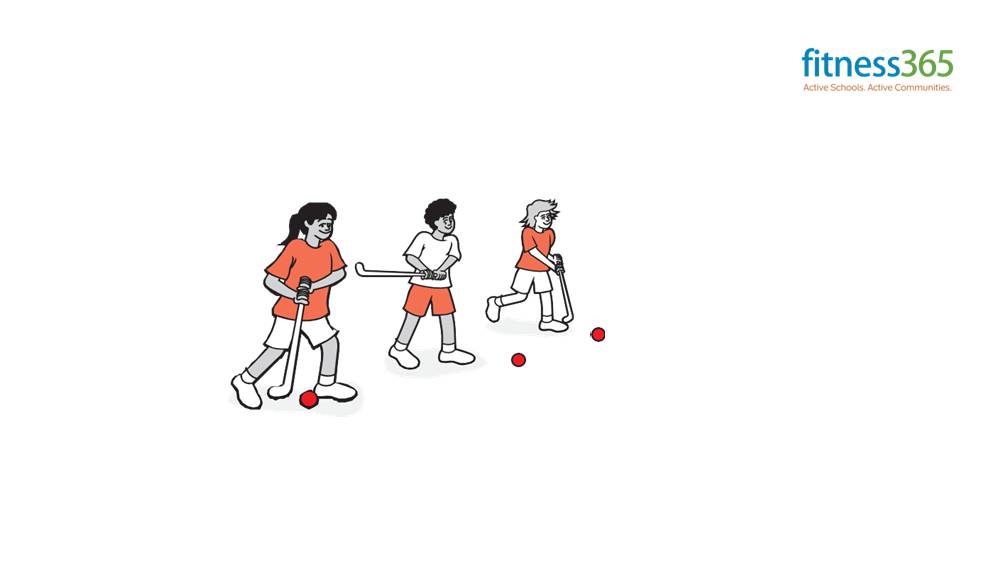
Controlling a small ball with a long implement (hockey stick), space awareness (pathways and direction), and different speeds.
Set-up
- Hockey sticks, small balls, markers.
- Children are freely spaced in a defined grass or hard area, each with a hockey stick and ball.
Activity
- move the ball with your stick and keep it close to you while standing still/ walking/jogging
- stop the ball and then continue
- change direction
- dribble along a line
- change speed without stopping
- dribble in circles, squares, zigzags, etc
- stop and turn in different ways
Variations
Dribbling pathways: Set out cones in different shapes, (e.g. triangle, circle, zigzag), dribble in a given direction, forward, reverse, in, and out of the cones.
Vary speed: On a signal, change speed.
Vary equipment: Carry out above activities with hand/foot dribbling.
by Neetu | Jun 2, 2020 | Fitness Activity
Movement skills/concepts
Bouncing and striking a ball with a bat/racquet while running.
Set-up
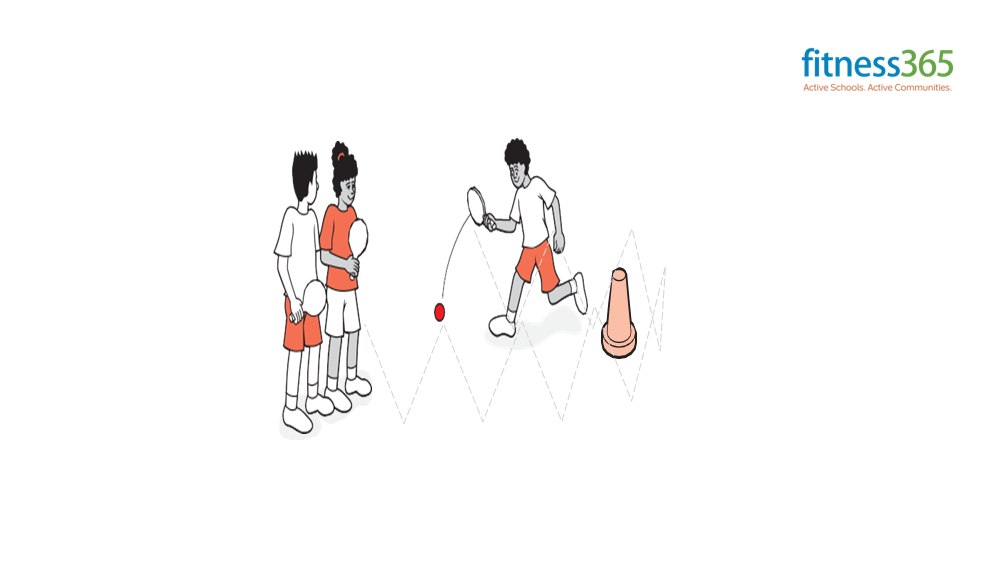
- A hard area with a start line, a return line about 3 metres away and a marker 10 metres away.
- Racquets/bats, small balls, markers/cones.
- Each group of four children stands one behind the other, with a racquet/bat each and a ball for the group, behind a start line.
Activity
From the start line, the first player runs and bounce dribbles the ball around the marker and back to the return line. They then stop and bounce hit the ball to the next player in line.
Now each group changes position. Two players stand at each end, with a ball and a neutral space between. The front player at each end bounce dribbles to the neutral space, stops, hits the ball across to the other player, then bounce dribbles back to the waiting player.
- eyes on the ball
- swinging with the whole arm
- wrist up
Variations
Vary action: Bounce the ball on the racquet instead of dribbling.
Vary hit: Designate backhand or forehand.
Vary the type of implement/object: Use a shuttlecock, a table tennis bat and ball, or a hockey stick and ball.
by Neetu | Jun 2, 2020 | Fitness Activity
Movement skills/concepts
Bouncing, balancing, and striking a ball with a bat/racquet, space awareness, (levels and pathways), and relationships.
Set-up
- Racquets, padder tennis bats, small balls/balloons, hoops.
- In a defined hard area, children spread out with a ball and racquet/bat each.
Activity
- put your racquet on the ground and pick it up
- balance the ball on one side of the racquet
- balance the ball and move around
- without changing grip, balance the ball on the other side of the racquet
- hit the ball up to head height with palm up/down, then alternating palm up/down
- try the above with the other hand
- hit the ball up moving forwards/backward/sideways/along specified lines and in a circle
- hit the ball up 10 times without letting it hit the ground
- using the racquet bounce the ball on the ground standing still/running
In pairs, who can …?
- drop the ball and hit it a short distance for your partner to catch
- drop the ball and hit it to bounce to your partner
- hit the ball backward and forwards with a partner
- find a wall and take alternate hits against it
- hit the ball backward and forwards over a net/bench/rope
- continue the above while facing side on to the direction of your hit
- continue the above alternating forehand and backhand
Variations
Vary the type of implement: Try different racquets, bats, balls, and shuttlecocks, modifying activities to suit.
by Neetu | Jun 2, 2020 | Fitness Activity
Movement skills/concepts
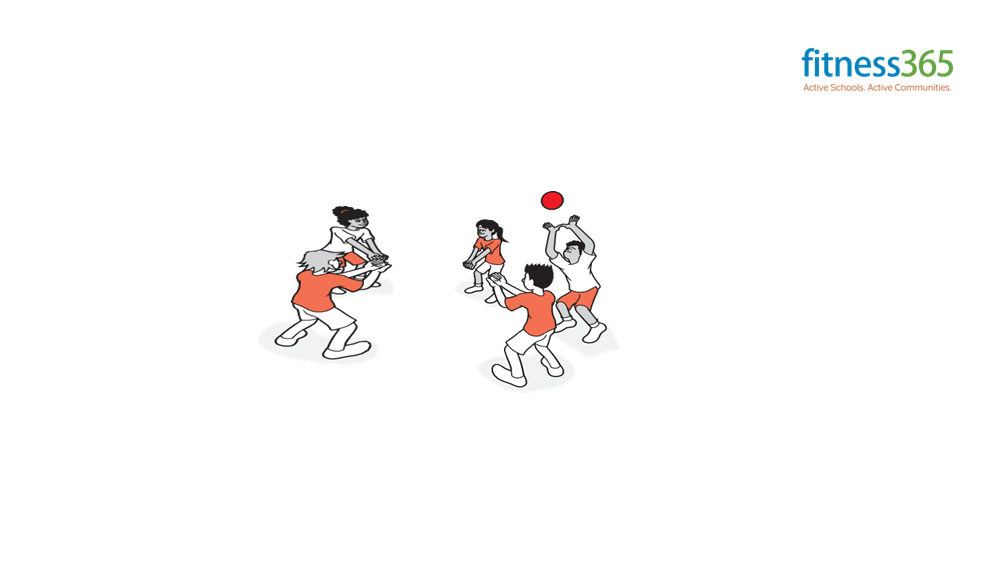
Striking a ball in the air (volley, serve, bump), body awareness, and judging flight path.
Set-up
- Lightweight balls.
- Teams of five–six, with one ball per group, spread out in circle formation in a hard court area.
Activity
Each team tries to keep its ball in the air by volleying it from player to player. The ball may be hit to any player in the circle. The winners are the team that makes the highest number of volleys in a row without the ball bouncing. Players may use any kind of volley: underarm strike, bump, or overhead volley.
- communication among team members
- moving feet to get into position
- hitting the ball with flat surface upward
- following through
Variations
Simplify the game: Allow one bounce between each hit. Place a player in the middle.
Extend skills: Allow only one kind of pass.
by Neetu | Jun 2, 2020 | Fitness Activity
Movement skills/concepts
Underhand strike (serve), two-handed forearm pass (bump), judging speed and direction, and moving into position to play the ball.
Set-up
- Lightweight balls that will bounce.
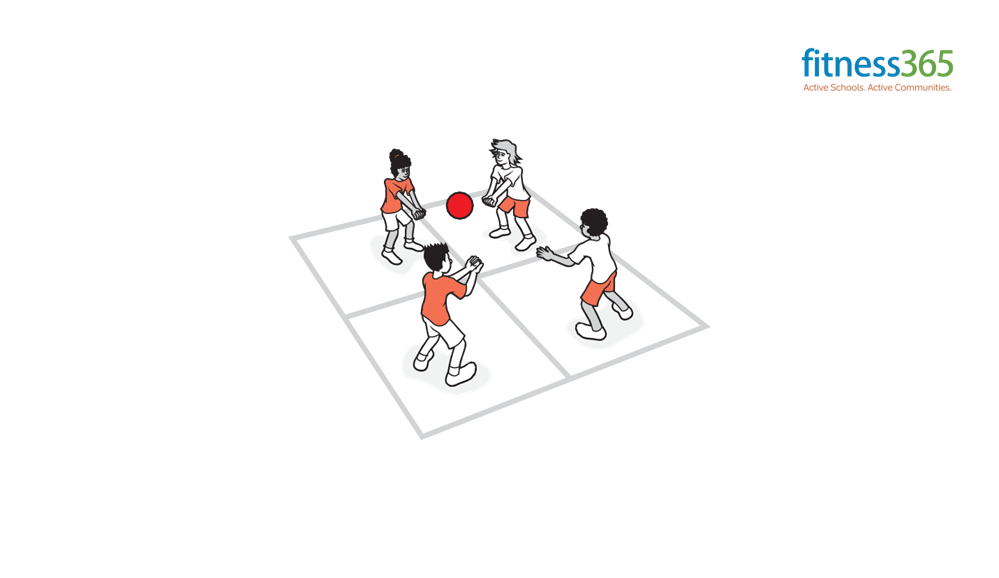
- Hardcourt area marked out in squares (2 meters wide approximately): some sets of four squares and some sets of two squares.
- Groups of either two or four, each group with a ball: a player stands in each square.
Activity
Children play Four Square or Two Square.
One player starts the game by serving the ball underhand after one bounce and, for Four Square, hitting it to any player in the other three squares or, for Two Square, hitting it to the other player. The player receiving the ball must keep it in play by striking the ball with an underhand strike (bump) to any square on the full.
Play continues until a mistake is made, such as where a player is not able to return the ball, hits the ball by sidearm or overarm, or catches the ball and steps into a square occupied by another player.
After each rally, rotate positions and change the server.
Play the game:
- cooperatively, by counting the number of volleys made by your group before a mistake
- competitively, by hitting the ball to others in your group (Four Square) so that it makes it hard for them to return the ball
Variations
Develop game: Children modify the game to include scoring and rules.