by Neetu | Jun 2, 2020 | Fitness Activity
Movement skills/concepts
Dribbling with a long implement, trapping a moving ball, stick, changing speed and direction.
Set-up
- Hockey sticks and small balls, hoops/chalk.
- Groups of two-three, with one ball per group and one stick per player.
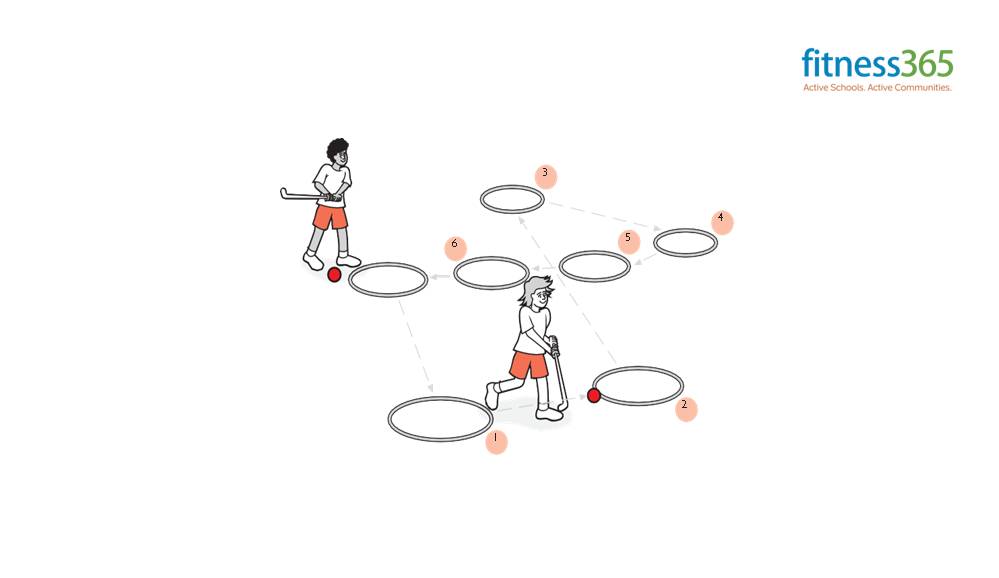
- A course (level grass or hard surface) is marked out with hoops or chalked circles, which function as ‘bus stops’ and are numbered in order.
Activity
In each group, each player, in turn, dribbles the ball around the course, stopping at each bus stop. How quickly can you do it?
- controlling the ball with the implement
- placing stick over the ball to stop it
Variations
Vary equipment: Try hand or foot dribbling.
Vary Set-up: Put a ball at each bus stop. When players get to a bus stop, they exchange their ball with the one that is there and move on to the next bus stop. The second player starts when the first reaches the bus stop 3.
by Neetu | Jun 2, 2020 | Fitness Activity
Movement skills/concepts
Striking with a long implement (golf club) in different directions, at different speeds and towards a stationary target, relationships (with objects) and body awareness.
Set-up
Golf clubs, a variety of small light (foam or plastic) balls, hoops, a variety of objects for targets (targets suitable for wall include masking tape, chalk marks, and suspended hoops; possibilities for the ground include bins, seats/chairs/trees, playground equipment, and markings).
Children are spread out in a hard or grass area with a wall. If inside, have mats on the ground to protect the floor.
Activity
Children have a club each and a variety (about five) of small lightweight balls. They practice the following tasks:
- swing the club back and forth like a pendulum, scuffing the grass/mat – check there is no one behind you or in front of you
- stand approximately four giant steps away from a hoop, stand beside your ball and swing your club (pendulum motion) to see how many balls you can get into a hoop
- find a space approximately four giant steps away from a wall or fence, stand beside the wall/fence and strike the ball so that it travels to the wall/fence; if it comes back to you, stop it before you hit it again
- strike the ball to the wall, so that it goes along the ground, and then try to hit it in the air
- see how many times you can hit the range of targets on the wall, fence or ground
Variations
Vary skill and equipment: Strike the ball with feet/hand(s), softball/cricket bats or hockey sticks.
by Neetu | Jun 2, 2020 | Fitness Activity
Movement skills/concepts
Striking a stationary ball at a stationary target.
Set-up
Batting tees (cricket or softball), bats or sticks, small balls, hoops.
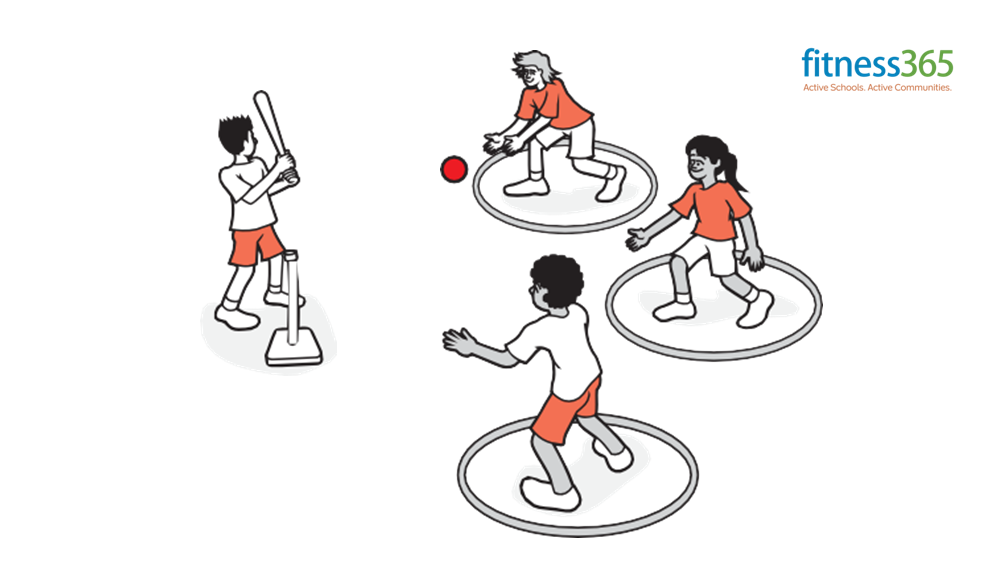
In each group of four, a batter stands at the tee and the others are fielders in hoops spread in front of the tee in a large grass area.
Activity
As the batter hits the ball off the tee, they name the fielder they are hitting to. That fielder must keep one foot in the hoop and attempt to field the ball.
The batter scores a point if the fielder is successful. The batter has three turns, then changes roles with a field
- gripping with hands together
- backswing, hands level with the shoulder (softball bat)
- step and swing
- following through
Variations
Toss ball: Skilled players can hit a moving ball, (e.g. toss the ball up and hit, or hit a slow-pitched ball or bowl).
Vary equipment and skill: Use a golf club or hockey stick.
by Neetu | Jun 2, 2020 | Fitness Activity
Movement skills/concepts
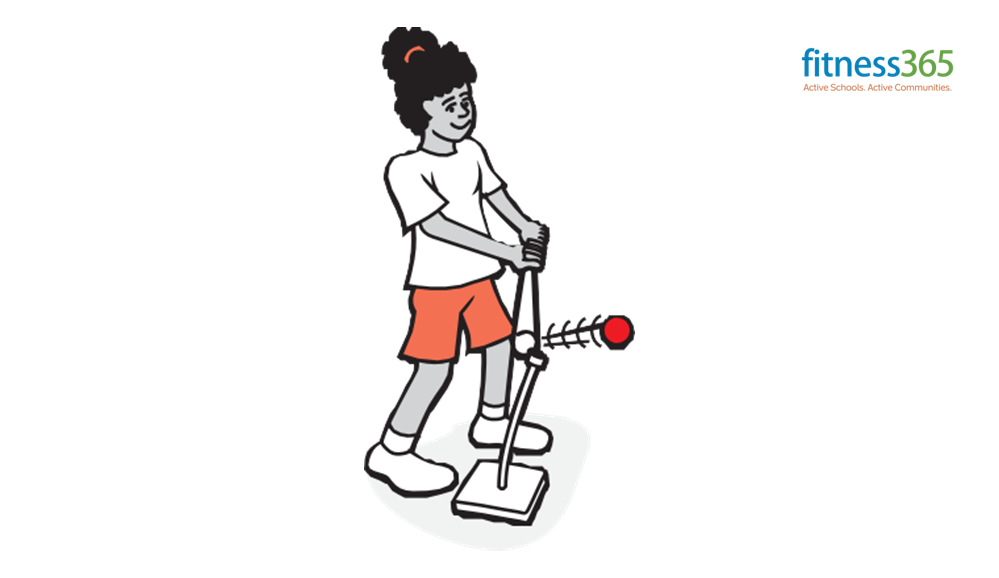
Striking a stationary ball off a tee, relationships (with others), time, and energy.
Set-up
Softball bat or bat shapes, small balls, batting tees, markers. Batting tees are spread out along a line in a defined grass area. A group of 4 children is at each tee, with a bat and three balls.
Activity
One person in the group is the batter; the other three are the fielders. In turn, the batter hits the three balls:
- in the direction of the fielders
- indifferent directions
- for distance
- between two markers
- along the ground
- to the same place
Variations
Extend skills: As skill level improves, try the same activities with the ball lobbed for the batter to hit on the full.
by Neetu | Jun 2, 2020 | Fitness Activity
Movement skills/concepts
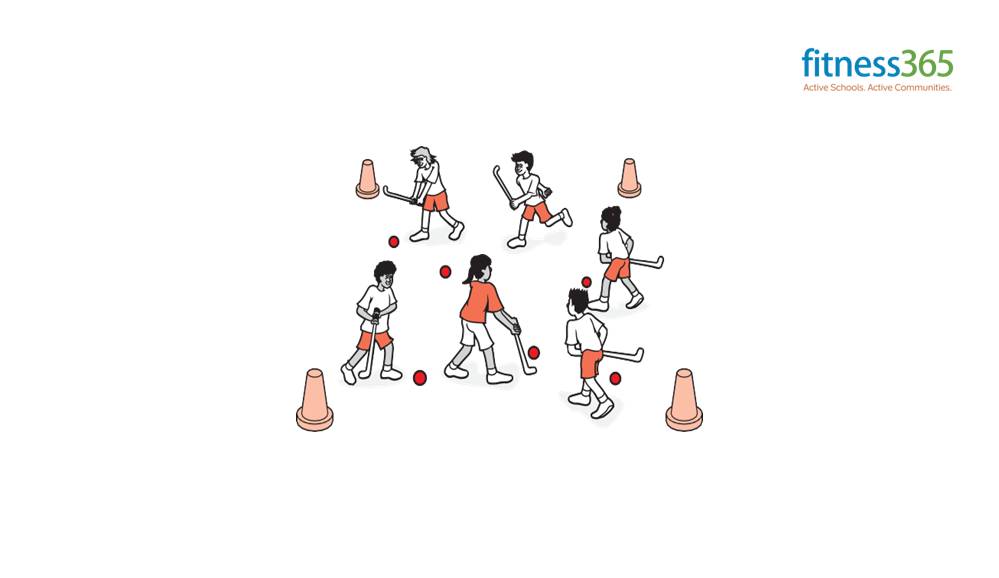
Controlling a ball with a hockey stick, pushing and hitting a stationary ball, space awareness, body awareness, time and energy, and relationships (with others).
Set-up
- Small balls, (e.g. soft/tennis balls), hockey sticks, markers/cones.
- Children are spread out in a defined level grass or hard area, each with a stick and ball.
Activity
- push the ball a short distance, follow and stop it
- push the ball to space, stop it, then push it to another space in a different direction
- push the ball as softly/firmly/quickly as you can
- push the ball in different pathways (forwards, backward, in a straight line, in a circle)
- push the ball with jerky/smooth movements
- hit the ball with everyone else, when all are facing the same way
In pairs with a stick each and one ball, can you …?
- push the ball gently to each other
- move back, approximately 5 meters apart, and see how many pushes you can do in 30 seconds
- hit the ball to each other
- put a marker between you and push/hit the ball at the marker
- push/hit the ball to your partner, then move to a new place to receive the return
Hitting
- hands together with left hand on top
- eyes on the ball and easy swing
- left shoulder pointing in direction of the ball
- hitting the bottom half of ball and follow-through
Variations
Vary equipment: Use different implements, (e.g. golf club or cricket bat).
Accuracy: Include a variety of stationary targets for the children to aim for by either pushing or hitting the ball.