by Neetu | Jun 9, 2020 | Sports
Movement skills/concepts
Controlling a ball in space, kicking for accuracy, body control, foot dribbling, space awareness (pathways and directions).
Set-up
- Balls, targets/goals (cones, ropes, milk bottle containers, sticks, hoops).
- Children, with one ball each, spread out in a defined grass or hard surface area where a variety of goals are laid out at different levels.
Activity
Each child dribbles with their ball at their own speed in the designated space, avoiding other people and obstacles. On the whistle, the children dribble to an open space and kick for a goal. They then retrieve the ball and begin dribbling again, listening for the signal to kick for a goal.
Can you see …?
- head up to avoid collisions with other people
- the gentle tapping of ball
- following through after kicking
You could ask …
Were you successful with your kicking for the goal? What do you think was the reason for this?
What do you need to do to be consistently accurate when kicking for the goal?
Variations
Vary speed: Children move around the space faster or slower.
Introduce a new role: Add a goalie.
by Neetu | Jun 9, 2020 | Sports
Movement skills/concepts
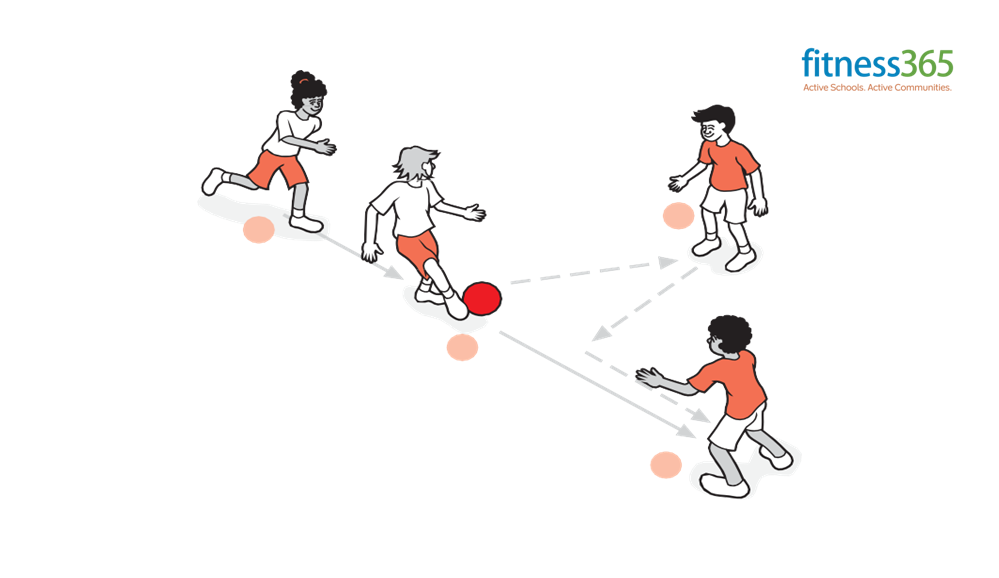
Receiving a pass, ball control, kicking to a stationary target and kicking to a moving target.
Set-up
- Large balls.
- Each group of four has a ball and works in a level grass or hard area.
Activity
- looking at the receiver, looking at the ball
- bent knee, swinging from the hip
- the non-kicking foot beside the ball
- well ‘weighted’ pass
- ‘attacking’ the ball
You could ask …
How will you control the ball when you receive the pass from Player 2? When receiving the pass from Player 2, where are you looking?
Variations
Add defence: Introduce a fifth player in the centre as a defender who challenges each player as they start. Start with passive defence, then change to more active defence (trying to steal the ball).
by Neetu | Jun 8, 2020 | Sports
Movement skills/concepts
Kicking a stationary ball for distance, ball control, balance, and relationships (with others and equipment).
Set-up
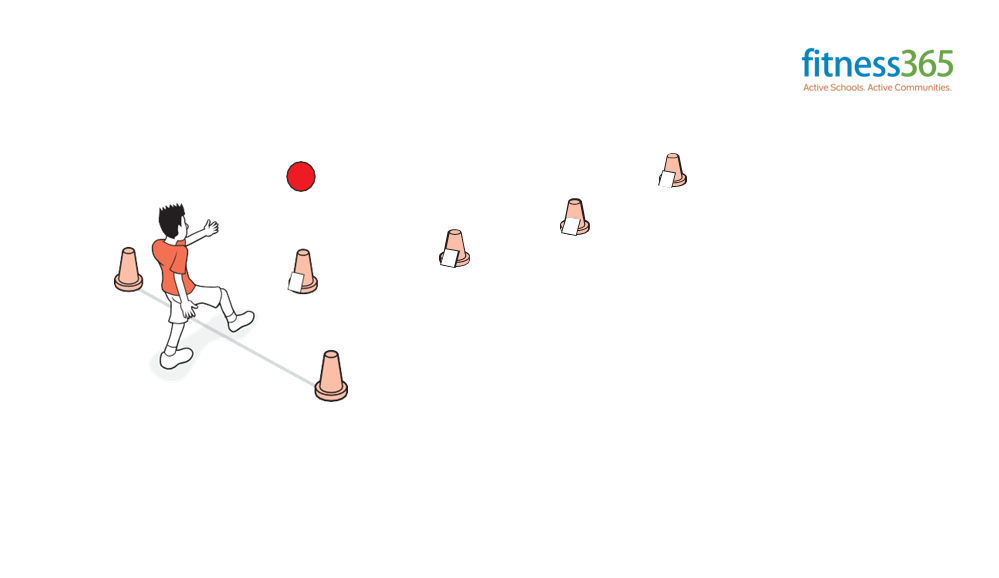
- Cones/markers, large round or oval balls, rope for kicking line.
- Starting from the kicking line, cones/markers are spaced at 3-meter intervals across a playground or field area and are numbered in sequence so that children can see their distance and score higher for further distances.
- Children work individually and in pairs, with one ball each.
Activity: Working by yourself, can you …?
- place your ball at the kicking line, step back about two giant steps, run in and kick the ball as far as you can – note which zone your ball landed in
- practice again and try to increase your distance
Working with a partner, let’s see …
- how far each of you can kick in five kicks; add up your scores – who can kick the furthest?
- if you can kick the ball to land on the full in each of three zones that your partner chooses for you – how many attempts does this take?
Can you see …?
- introducing step–hop on the non-kicking leg
- contacting under the center of the ball
You could ask …
Where do you contact the ball to lift it for maximum distance?
What adjustments do you need to make to your kicking action to land your ball in the three different zones selected by your partner?
Variations
Add targets: Include targets, (e.g. cones, bases, hoops) in each of the zones so children are aiming for accuracy and distance.
by Neetu | Jun 8, 2020 | Sports
Movement skills/concepts
Receiving a pass and kicking along the ground under control while moving.
Set-up
- A variety of large balls.
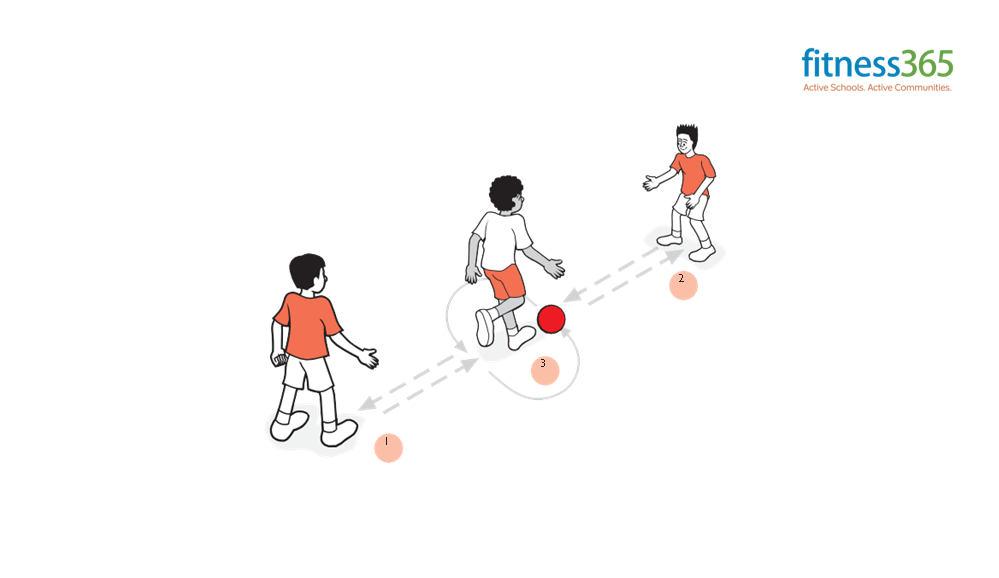
- Each group of three spreads out in a line on level grass or hard area; the end player (Player 1) has a ball.
Activity
Player 1 passes to Player 3 (in the center) who controls the ball and returns it. Player 1 passes to Player 2, while Player 3 turns to receive the ball from Player 2 and returns it. After a given number of passes, change the center player.
Can you see …?
- controlling before passing
- contacting with the inside of the foot
- swinging from the hip
- following through in the direction of the ball
You could ask …
How do you control the ball in the middle when you return it? Which part of your foot do you strike the ball with?
How do you control the ball along the ground?
Variations
Provide one ball per player: Players 1 and 3 exchange balls, then Player 3 turns and exchanges with Player 2.
by Neetu | Jun 8, 2020 | Sports
Movement skills/concepts
Dribbling with the feet, moving at different speeds and in different directions.
Set-up
- Large balls.
- Children, each with a ball, are freely spaced in a defined grass or hard area.
Activity
The players dribble freely. When the leader:
- calls a number, they form groups of that number and dribble in a small circle
- tells them to spread out, they dribble freely until another number is called
Can you see …?
- using all parts of the feet
- keeping the ball close
- seeing the ball, seeing others
You could ask …
How well are you controlling the ball? What can you do to improve or to challenge yourself?
Variations
Change pattern: Dribble in a circle or a square, reverse, and go the other way or follow the leader.
Change speed: Dribble while walking, jogging, running.
Vary equipment and skills: Hand dribble, or hockey dribble with a stick and small ball.
by Neetu | Jun 8, 2020 | Sports
Movement skills/concepts
Dropping a ball to punt, kicking a ball up in the air, space awareness (levels and body parts), and body awareness.
Set-up
- Balloons, lightweight kicking balls, goals (rope or elastic suspended between two uprights/chairs).
- Wall or netting fence around the perimeter of grass or hard court area. Children work in pairs, sitting, and then standing.
Activity: Sitting
Children in pairs discuss the following questions:
- What is punting?
- Which games/sports use punting skills?
- What words would you use to describe what a punt is?
- Which sportspeople do you know who are good at punting?
- Why do you think they are good at punting? What have you seen them do?
- What do they do with their legs, feet, body?
Standing up, pretending
Let’s pretend we are punting a ball:
- How high did it go? Did it go over a goal?
- What did we do with our arms, legs, feet?
Standing up, having a go
Let’s have a go at punting: stand up, with a ball, spread out in the playing area and face a wall, netting fence or partner.
Can you …?
- holding the ball in two hands, drop it to the ground in front of you, then, after the first bounce, contact the ball with your shoelaces (top of shoe), kicking it to the wall or your partner
- try kicking with your left and right feet to find out which foot you prefer to kick with
- with your preferred kicking foot, drop the ball in front of you and make contact with it before it touches the ground. Practice this a few times. Try to kick it towards the wall or your partner – you are now punting!
- punt over a low height? Stand three giant steps behind the goal (this is your kicking line) and punt the ball so that it travels over the rope. Count how many times you have a go and how many times you are successful. Using our maths brain, what do we call this?
- take a series of quick steps up to the kicking line and punt over the goal
Can you see …?
- holding the ball in two hands
- guiding the ball onto the foot
- swinging from the hip
- contacting the ball with the shoelaces
- keeping head down
- following through
- using both left and right feet to kick the ball
You could ask …
What did you like about punting? What did you find hard about punting?
Variations
Explore space: Can you punt the ball so that it comes back to you, goes behind you, goes high/low/along the ground?