by Neetu | Jun 9, 2020 | Sports
Movement skills/concepts
Dribbling and controlling a ball with feet, trapping and kicking a ball, varying speed and direction.
Set-up
- Balls, hoops.
- Grass or hard surface area with a boundary.
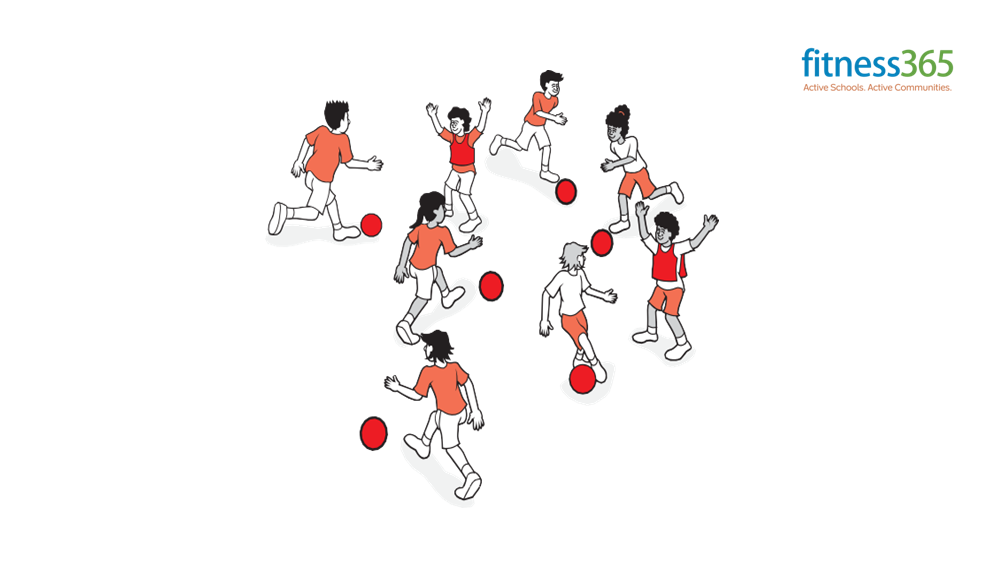
- Groups of 6: three spiders, each standing in a hoop (web); three dribblers, each with a ball.
Activity
On ‘Go’, the three dribblers dribble around the area. The spiders try to steal the ball from the dribblers. They are allowed to kick the ball away as long as one foot remains on the web.
On ‘Stop’, the dribblers stop the ball dead. On ‘Go’, they move in a different direction. On ‘Change’, all players change roles.
Can you see …?
- using both the outside and inside of the foot to touch the ball on both sides
- seeing the ball, seeing others
- keeping the ball close
You could ask …
How can the dribblers protect the ball from the spiders? What can the spiders do to steal the ball from the dribblers?
Variations
Vary equipment and skills: Hand dribble with a large ball, or hockey dribble with a small ball.
Vary Set-up: Place the hoops in a circuit, which the dribblers attempt to complete without the spiders kicking/hitting away their ball.
by Neetu | Jun 9, 2020 | Sports
Movement skills/concepts
Dribbling and controlling a ball with feet, changing direction, dodging, and evading.
Set-up
- Large balls, and bibs or bands.
- Grass or hard area, about one third the size of a netball court.
- Groups of approximately six-eight: one or more taggers with a bib or band each; one ball per player.
Activity
All players dribble freely. Taggers attempt to tag others with their hand as they dribble and still keep control of their ball. When a tag is made, the players change roles.
Can you see …?
- keeping the ball close
- use of space
- seeing the ball, seeing others
You could ask …
Where in the area could you move to avoid being tagged?
How can you work with the other taggers to try to tag a player?
Variations
Vary a number of taggers: Anyone can tag and see how many tags they can make.
Vary equipment and skills: Hand dribble with a large ball, or hockey dribble with a small ball.

by Neetu | Jun 9, 2020 | Sports
Movement skills/concepts
Kicking a moving ball, kicking to a moving player, relationships (with others), and moving into space.
Set-up
- Large balls.
- Each group of three works in a level grass or hard surface area; the center person (Player 1) has the ball.
Activity
Player 1 passes to Player 2, who returns the pass. Player 1 then passes to Player 3, who returns it.
Start from a stationary position, then increase the speed as skill improves – to walking, to jogging, to running.
Rotate positions.
Can you see …?
- looking at the receiver, looking at the ball
- pushing with the inside of the foot
- following through with the kicking foot
- passing ahead of the receiver
You could ask …
Where do you aim to pass the ball when you are walking? What about when you are running?
Why is the follow-through important in kicking the ball?
Variations
Vary area: Increase the distance between the players.
by Neetu | Jun 9, 2020 | Sports
Movement skills/concepts
Dribbling with the feet and stealing the ball with the feet.
Set-up
- Large balls, markers, and cones.
- In a defined hard surface or grass area, children work in pairs, with one ball per pair.
Activity
Children select a partner who has similar skills. Each pair decides its own boundaries; a smaller area requires more practice.
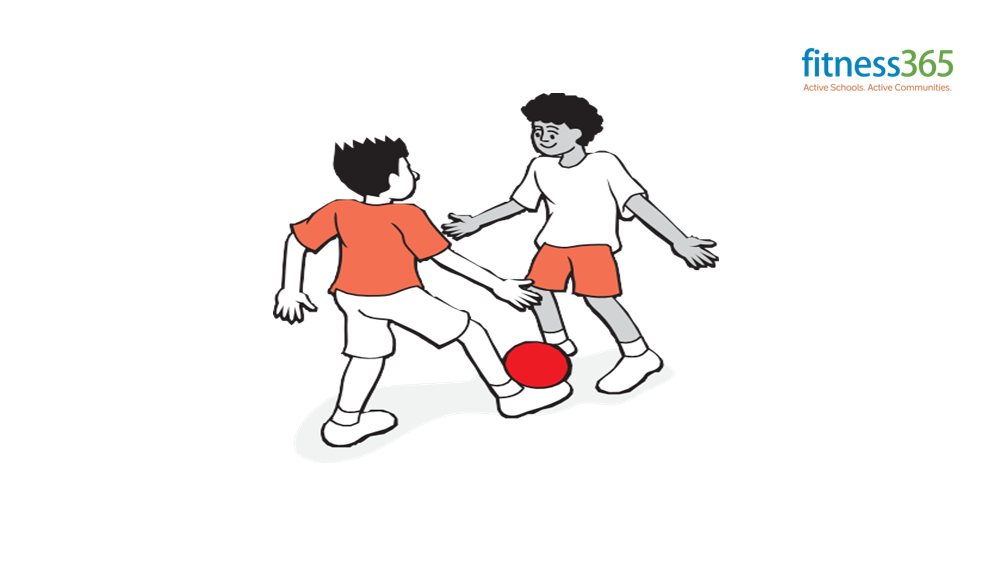
Partner 1 begins to travel and dribble the ball within the defined area; Partner 2 attempts to steal the ball by using their feet to trap the ball or tap it away. If Partner 2 gains possession of the ball, they become the attacker and Partner 1 becomes the defender.
Rules include no body contact; gain possession of the ball; don’t kick it away.
Repeat the activity, and include a goal. The object of the game is for the attacking player to
score a goal, while the defender tries to keep the attacker from scoring using the rules above. If the defender gains possession of the ball before the attacker scores a goal, the defender dribbles the ball to a designated spot on the boundary and then becomes the attacker. If a goal is scored, the attacker and defender switch roles.
Can you see …?
- gentle tapping of the ball when dribbling
- head up looking around
- ball control with inside/outside of the foot
- offense – looking for open spaces to move into
- defense – trapping or tapping to gain possession
You could ask …
When you are the attacker, what can you do to keep the ball away from your partner?
When you are defending, what can you do to gain possession of the ball?
Variations
Create your own game: Work with your partner to design a game using the skills of soccer. Consider the rules, how you will score, what the boundaries will be, and a name for your game.
Play two-on-two: Partners play the game they have designed against another pair.

by Neetu | Jun 9, 2020 | Sports
Movement skills/concepts
Dribbling in pathways, kicking for accuracy, kicking over a low height, and relationships (with others).
Set-up
- A variety of obstacles and targets, (e.g. rubbish bins, storage boxes, marker cones, discs/bases, hoops, benches, chairs).
- A hard surface or grass area is set out like a golf course, with bins and boxes to dribble around, cones to zigzag through, hoops to kick into and poles to kick over.
Activity
The object of the game is to complete the course with the fewest number of kicks possible.
Children count the number of kicks it takes to complete the course.
When they have finished the course, they go again trying to lower their score.
Can you see …?
- gentle tapping of the ball for dribbling
- contacting ball directly behind it for kicking along the ground
- contacting ball below its center for kicking over a low height
You could ask …
Which kind of kick did you select for the large obstacles like the bin? To lower your score, what do you need to do?
Variations
Introduce a partner: Alternate kicks with a partner and have a challenge with another partner.

by Neetu | Jun 9, 2020 | Sports
Movement skills/concepts
Kicking a stationary ball for accuracy, ball control, and defending a goal.
Set-up
- Goals (cones) and large softballs.
- In a grass or hard surface area, children work in pairs: one kicker and one goalie; one ball per pair.
Activity
To score a goal, the kicker must kick from a stationary position and kick the ball along the ground.
The goalie is allowed to use any part of their body to stop the kicker from scoring a goal.
The kicker has five tries at goal, then the partners swap roles.
Can you see …?
- placing the non-kicking foot beside the ball
- following through after the kick
You could ask …
Goalies: How might you anticipate where the ball is going to be kicked?
Kickers: Why is it important to follow through when you kick the ball?