by Santosh | Jun 4, 2020 | Fitness Activity
Movement skills/concepts
Communication, walking, dynamic balance, space and body awareness, moving through, on, over and under obstacles.
Set-up
Hoops, benches, mats, blindfolds.
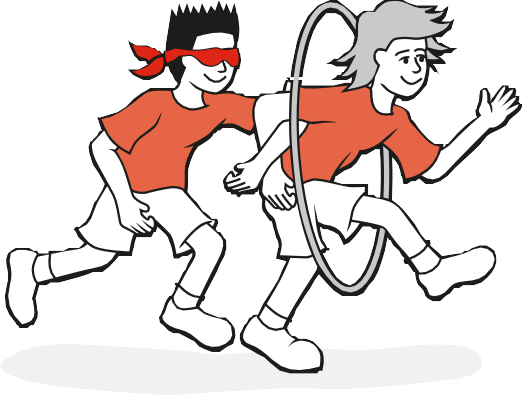
Children in pairs work in a defined area: one partner is ‘snow-blind’ (with eyes closed or blindfolded) and the other can see.
Activity
Two children are trapped in a snowstorm and are trying to find their way home.
The objective is for the seeing partner to lead the ‘snow-blind’ partner through the blizzard (obstacle course) to safety. They go through a snow tunnel (hoop) and under an ice log (bench). Partners hold hands or link arms and try not to let go so neither one gets lost in the storm. Partners switch roles.
Can you see …?
• leader giving clear instructions
• snow-blind partner putting trust in leader
You could ask …
What type of instructions were the easiest to understand? How do you build up trust in this situation?
Variations
Vary form of communication: Instead of talking and holding hands, partners use a code such as finger clicks, claps or hums.
COOL DOWN/ CLOSURE
Review Skill/Activity, stretching, and questions.
by Santosh | Jun 4, 2020 | Fitness Activity
Movement skills/concepts
Pivoting, turning around a long axis, running or walking skills and relationships (with others).
Set-up
Defined grass or hard area.
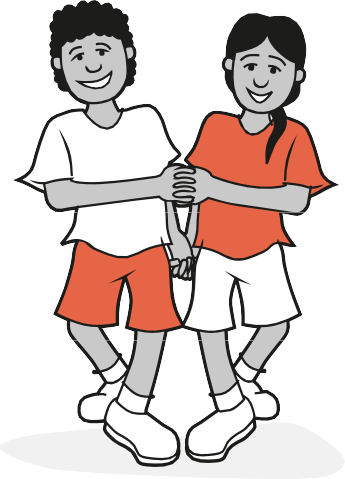
Children in pairs stand side by side and join hands together in front.
Activity
Pairs move freely around the marked area. To avoid bumping into any other pair, the couples pivot turn and run in another direction when they meet.
Can you see …?
• quick pivot turn on the balls of the feet, quarter turn to half turn only
• head up to see other pairs
You could ask …
How will you and your partner work together to pivot and turn?
Variations
Change locomotor skills: Use walking, skipping, hopping or jumping.
COOL DOWN/ CLOSURE
Review Skill/Activity, stretching, and questions.
by Santosh | Jun 4, 2020 | Fitness Activity
Movement skills/concepts
Pulling, balancing on a moving object, space awareness and relationships (with others).
Set-up
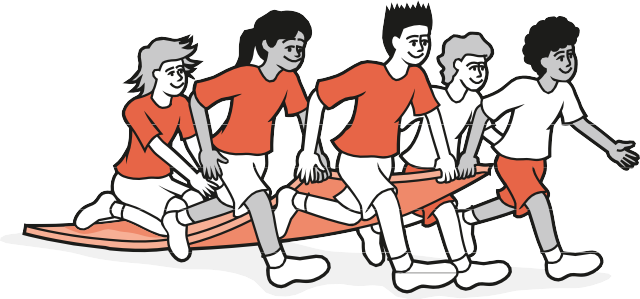
Gym mats (magic carpets) on a hard, smooth surface. Groups of approximately 7, with one mat per group.
Activity
Children take turns in having a ‘magic carpet’ ride on the mat, pulled by the rest of the group steadily around the defined area. The rider can be lying, sitting or crouching and can control the speed (‘slower’, ‘faster’ or ‘just right’).
Can you see …?
• rider balancing on a wide base of support
• children pulling safely under control
• children working cooperatively together
• enjoyment
You could ask …
- What was the best way of riding the ‘magic carpet’?
- Did your arms get tired from pulling the mat? How can you prevent this?
COOL DOWN/ CLOSURE
Review Skill/Activity, stretching, and questions.
by Santosh | Jun 3, 2020 | Fitness Activity
LEARNING OUTCOMES
Performs locomotor skills while maintaining balance
STUDENT TARGETS
Skill: I will perform locomotor skills to the rhythm of the music.
Cognitive: I will respond appropriately when the music starts and stops.
Fitness: I will participate in the activity in order to make my heart beat faster.
Personal & Social Responsibility: I will safely share space with classmates by standing inside a hoop with others and keeping my hands and feet to myself.
TEACHING CUES
- Move to the Music
- Find an Igloo when it Stops
ACTIVITY SET-UP & PROCEDURE
Equipment:
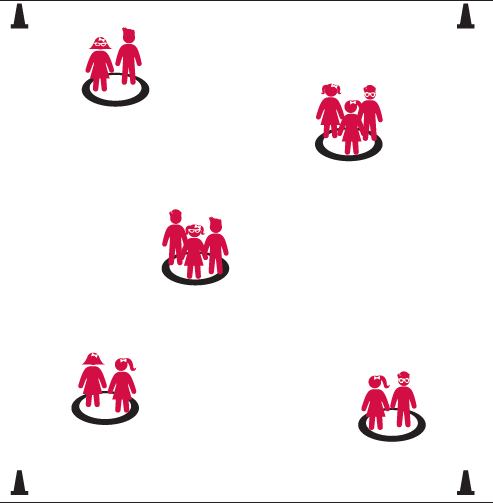
- 1 hoop per group of 2 or 3 students.
- Music and music player
Set-Up:
- Scatter hoops throughout the activity area with enough space for students to travel in between them.
- Send groups of 2 or 3 students to stand inside each of the hoops.
Activity Procedures:
- It’s cold outside and we need to share our Igloos with our friends!
- When the music starts, we’re going to carefully ice skate around our activity area without touching or stepping into a hoop.
- When the music stops, move to the closest hoop and get inside with at least 1 friend in order to warm up your toes. If there are too many friends in a hoop, move to a different hoop with a new friend. We’ll play again each time that the music starts.
COOL DOWN/ CLOSURE
Review Skill/Activity, stretching, and questions.
by Santosh | Jun 3, 2020 | Fitness Activity
LEARNING OUTCOMES
Demonstrates two of the five critical elements for jumping and landing in a vertical plane
STUDENT TARGETS
Skill: I will demonstrate jumping and landing, following the teaching cues given in class.
Cognitive: I will listen to and safely follow all directions without any help from the teacher.
Fitness: I will stay safely active during No More Monkeys.
Personal & Social Responsibility: I will use equipment and space within the activity area appropriately in order to keep my classmates and myself safe.
TEACHING CUES
Traveling Cues
Jumping Cues
- Bend to Get Ready
- Extend Up
- Stretch for the Sky
- Bend to Land Soft
ACTIVITY SET-UP & PROCEDURE
Equipment:
1 poly spot per student
Set-Up:
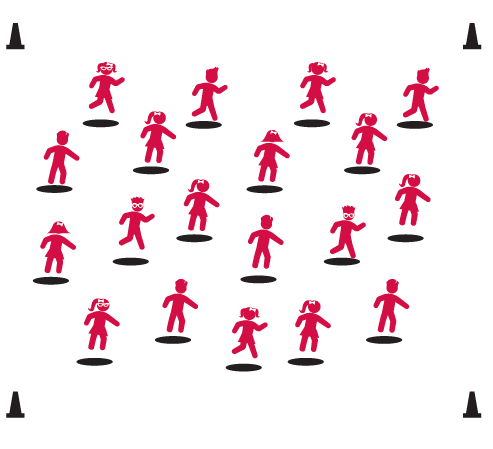
- Scatter poly spots throughout a large activity area.
- Each student to a poly spot.
Activity Procedures:
- Raise your hand if you know the song 10 Little Monkeys. It’s not safe to jump on a real bed like the monkeys in the song do. To be safe, we’re going to pretend that our poly spots are beds…and we’re monkeys!
- On the start signal, everyone is going to skip to find a new bed to jump on. When you get to a new bed, jump with 2 feet onto the spot and sing, “10 little monkeys jumping on the bed…”
- When you’re done with the song, skip to another bed and sing, “9 little monkeys jumping on the bed…”
- Continue skipping, jumping, and singing until you get all the way down to 1 little monkey.
- After you finish singing for 1 little monkey, sit crisscross on the final bed that you jumped on and sing,
“No more monkeys jumping on the bed!”
COOL DOWN/ CLOSURE
Review Skill/Activity, stretching, and questions.