by Neetu | Jun 9, 2020 | Sports
Movement skills/concepts
Dribbling in pathways, kicking for accuracy, kicking over a low height, and relationships (with others).
Set-up
- A variety of obstacles and targets, (e.g. rubbish bins, storage boxes, marker cones, discs/bases, hoops, benches, chairs).
- A hard surface or grass area is set out like a golf course, with bins and boxes to dribble around, cones to zigzag through, hoops to kick into and poles to kick over.
Activity
The object of the game is to complete the course with the fewest number of kicks possible.
Children count the number of kicks it takes to complete the course.
When they have finished the course, they go again trying to lower their score.
Can you see …?
- gentle tapping of the ball for dribbling
- contacting ball directly behind it for kicking along the ground
- contacting ball below its center for kicking over a low height
You could ask …
Which kind of kick did you select for the large obstacles like the bin? To lower your score, what do you need to do?
Variations
Introduce a partner: Alternate kicks with a partner and have a challenge with another partner.

by Neetu | Jun 9, 2020 | Sports
Movement skills/concepts
Kicking a stationary ball for accuracy, ball control, and defending a goal.
Set-up
- Goals (cones) and large softballs.
- In a grass or hard surface area, children work in pairs: one kicker and one goalie; one ball per pair.
Activity
To score a goal, the kicker must kick from a stationary position and kick the ball along the ground.
The goalie is allowed to use any part of their body to stop the kicker from scoring a goal.
The kicker has five tries at goal, then the partners swap roles.
Can you see …?
- placing the non-kicking foot beside the ball
- following through after the kick
You could ask …
Goalies: How might you anticipate where the ball is going to be kicked?
Kickers: Why is it important to follow through when you kick the ball?

by Neetu | Jun 9, 2020 | Sports
Movement skills/concepts
Controlling a ball in space, kicking for accuracy, body control, foot dribbling, space awareness (pathways and directions).
Set-up
- Balls, targets/goals (cones, ropes, milk bottle containers, sticks, hoops).
- Children, with one ball each, spread out in a defined grass or hard surface area where a variety of goals are laid out at different levels.
Activity
Each child dribbles with their ball at their own speed in the designated space, avoiding other people and obstacles. On the whistle, the children dribble to an open space and kick for a goal. They then retrieve the ball and begin dribbling again, listening for the signal to kick for a goal.
Can you see …?
- head up to avoid collisions with other people
- the gentle tapping of ball
- following through after kicking
You could ask …
Were you successful with your kicking for the goal? What do you think was the reason for this?
What do you need to do to be consistently accurate when kicking for the goal?
Variations
Vary speed: Children move around the space faster or slower.
Introduce a new role: Add a goalie.
by Neetu | Jun 9, 2020 | Sports
Movement skills/concepts
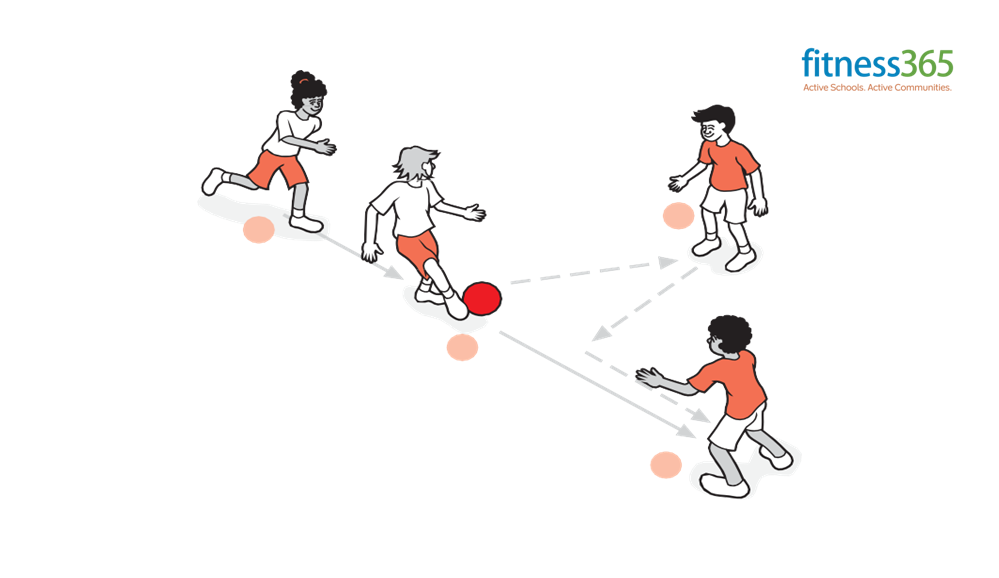
Receiving a pass, ball control, kicking to a stationary target and kicking to a moving target.
Set-up
- Large balls.
- Each group of four has a ball and works in a level grass or hard area.
Activity
- looking at the receiver, looking at the ball
- bent knee, swinging from the hip
- the non-kicking foot beside the ball
- well ‘weighted’ pass
- ‘attacking’ the ball
You could ask …
How will you control the ball when you receive the pass from Player 2? When receiving the pass from Player 2, where are you looking?
Variations
Add defence: Introduce a fifth player in the centre as a defender who challenges each player as they start. Start with passive defence, then change to more active defence (trying to steal the ball).
by Neetu | Jun 8, 2020 | Sports
Movement skills/concepts
Kicking a stationary ball for distance, ball control, balance, and relationships (with others and equipment).
Set-up
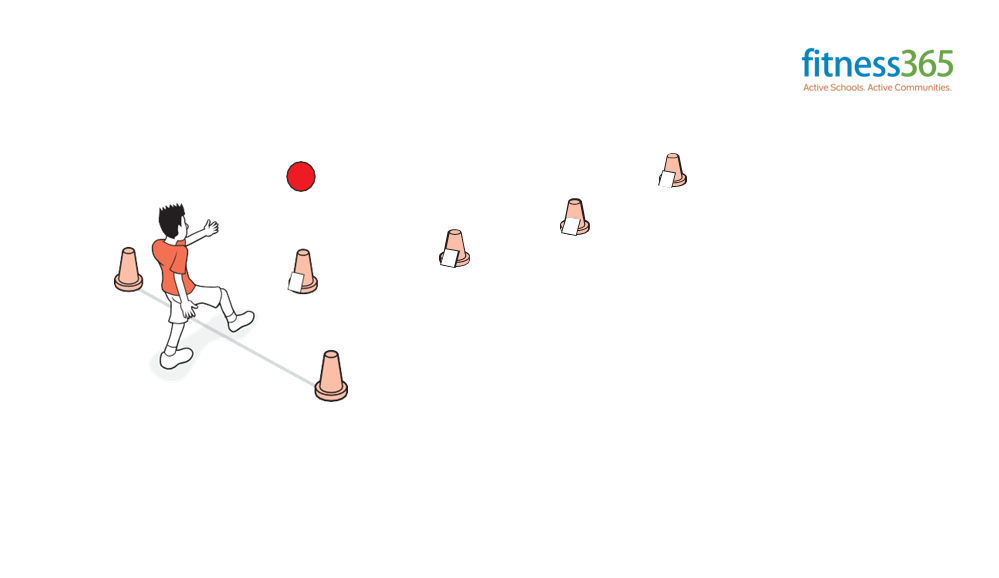
- Cones/markers, large round or oval balls, rope for kicking line.
- Starting from the kicking line, cones/markers are spaced at 3-meter intervals across a playground or field area and are numbered in sequence so that children can see their distance and score higher for further distances.
- Children work individually and in pairs, with one ball each.
Activity: Working by yourself, can you …?
- place your ball at the kicking line, step back about two giant steps, run in and kick the ball as far as you can – note which zone your ball landed in
- practice again and try to increase your distance
Working with a partner, let’s see …
- how far each of you can kick in five kicks; add up your scores – who can kick the furthest?
- if you can kick the ball to land on the full in each of three zones that your partner chooses for you – how many attempts does this take?
Can you see …?
- introducing step–hop on the non-kicking leg
- contacting under the center of the ball
You could ask …
Where do you contact the ball to lift it for maximum distance?
What adjustments do you need to make to your kicking action to land your ball in the three different zones selected by your partner?
Variations
Add targets: Include targets, (e.g. cones, bases, hoops) in each of the zones so children are aiming for accuracy and distance.