by Neetu | Jun 4, 2020 | Fitness Activity
Movement skills/concepts
Underarm throw for accuracy.
Set-up
Small balls, bucket/bin/box, targets on wall, ground targets like hoops, rope circles, bases, discs, markers as tees.
Activity 1: Frogs
- Each group of two-three, with one ball, is spaced around a bucket.
- Players take turns throwing
- the ball into the bucket. How many
- times can you throw the balls into the bucket?
Activity 2: Underarm darts
In a group of two-three, each player has a ball and stands in front of a wall target (numbers in a square, or a circle with several rings, like a dartboard).
Throw underarm five times and count your score.
Activity 3: Underarm golf
Ground targets (holes) are arranged as a ‘golf’ course, positioned at varying distances from one another and with a marker (tee) near each one.
Players throw from the starting tee until they can land the ball on the full on the first target. They continue in this way round the rest of the course, following the correct sequence.
Can you see …?
- eyes on target
- long arm swing
- stepping towards target
- following through
You could ask …
If you increase the distance from the target, what happens to your arm swing? To hit the target consistently, what do you need to focus on?
Variations
Increase difficulty: Increase the distance between tee and target.
Play with a partner: Have a competition to see who can score the most points with a limited number of throws.
by Neetu | Jun 4, 2020 | Fitness Activity
Movement skills/concepts
Rolling to a target, space awareness, and relationships (with others).
Set-up
- Balls.
- Smooth surface.
- Each group of six or eight stands in a circle about 4 meters in diameter. Opposite players are a pair: they have the same number and have one ball between them.
Activity
The player who has the ball rolls it across the circle to their partner, and then the other pairs of players do the same in quick succession. See how quickly they can complete this task.
Can you see …?
- ball in fingers
- stepping and rolling
- following through
Variations
Change the order of the rolls: The sequence goes from the pair with the highest to the pair with the lowest numbers, or from odds to evens, or in random order.
Increase the number of balls: Every player has a ball, with partners rolling to each other at the same time.
Vary equipment and skills: For example, in soccer, kick pass, or hockey push pass/hit.
by Neetu | Jun 4, 2020 | Fitness Activity
Movement skills/concepts
Rolling a ball to a stationary target, accuracy.
Set-up
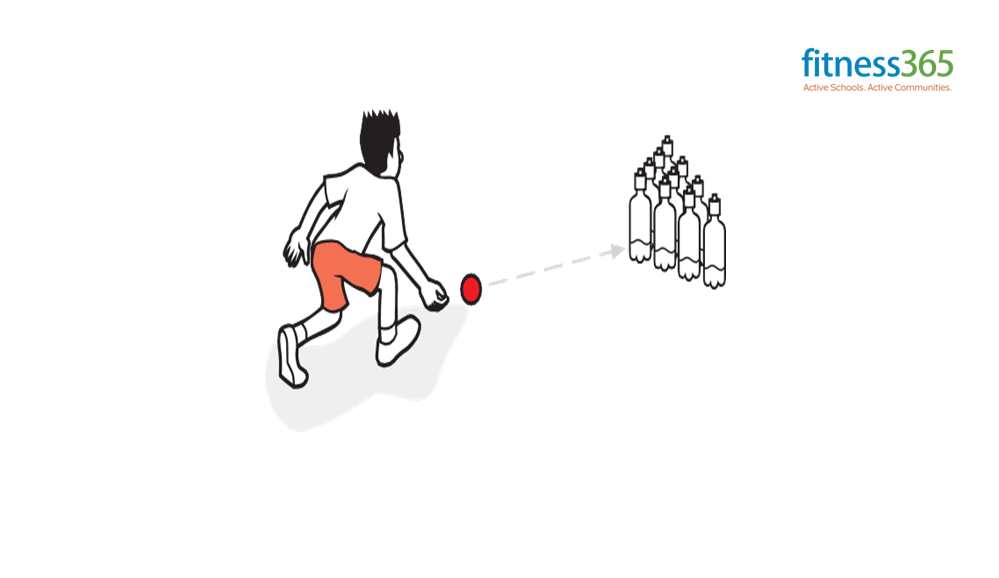
- Sets of 10 skittles (milk containers filled with sand, drink cans) and small balls. Skittles are arranged in the ten pin formation on a smooth hard surface.
- Each pair or group of four has a set of skittles and a ball.
Activity
- One player rolls at the skittles, another replaces them as they are knocked over and calls the score.
- Change roles after each turn.
Can you see …?
- eyes on target
- stepping in to roll
- low release
- following through
You could ask …
Where did you aim when all the targets were standing?
Did you vary the speed of your roll to knock down the targets?
Variations
Vary number: Decrease or increase the number of skittles.
Vary distance: Decrease or increase the distance of the skittles from the player.
by Neetu | Jun 4, 2020 | Fitness Activity
Movement skills/concepts
Catching a ball approaching at different levels, angles, and at different speeds, passing, and throwing.
Set-up
- A variety of small and large balls.
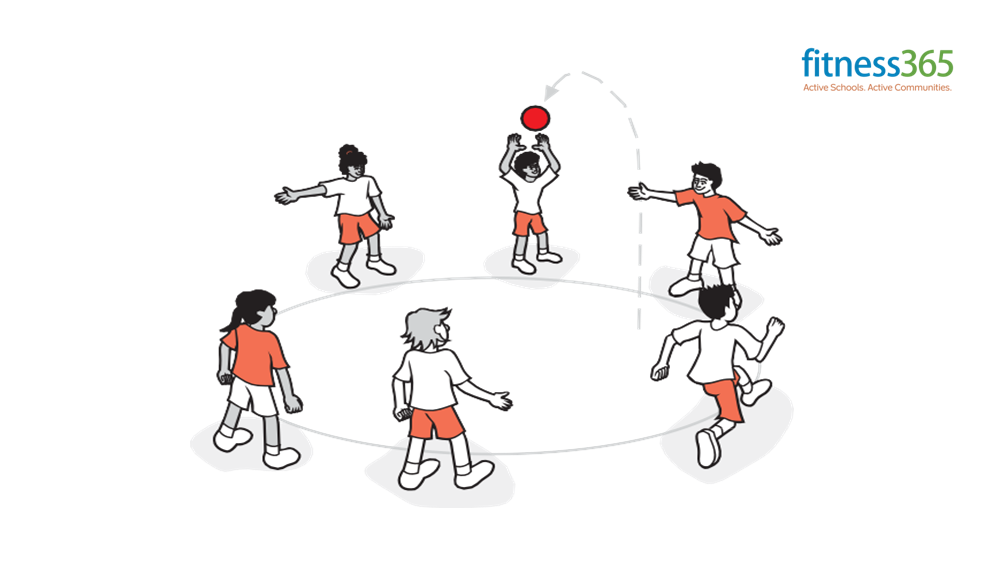
- Each group of six-seven, with one ball, stands in a circle in the grass or hard area.
Activity 1: Throw and catch
The player with the ball throws it to anyone in the circle other than an adjacent player. The thrower then runs around the circle to the catcher’s position while the catcher throws and runs.
Activity 2: Catchers against runners
The child with the ball throws it to one of the adjacent players, then runs around the circle back to their place. The remaining players pass the ball around the circle to see how many catches they can make before the runner gets back. If the first pass is dropped, the runner starts again.
Activity 3: Your ball
The thrower with the ball stands in the middle of the circle and throws the ball high, calling a player’s name. That player moves into the circle and the thrower takes up the player’s position outside the circle. The named player catches the ball, then throws it up while naming another player to catch. Continue.
Can you see …?
- eyes on the ball
- catch with soft fingers
- fingers pointing up for a ball above the waist, pointing down to catch a ball below the waist
- getting under the ball to catch it
You could ask …
How will you have your hands to catch a high ball?
Sometimes the ball pops out of our hands. How can you keep the ball in your hands? Where should you position your body to receive a catch?
by Neetu | Jun 4, 2020 | Fitness Activity
Movement skills/concepts
Two-handed pass to a stationary target, space awareness (pathways and patterns), and relationships (with others).
Set-up
- Large balls.
- Grass or hard area.
- Groups of five–six.
Activity 1: Circles
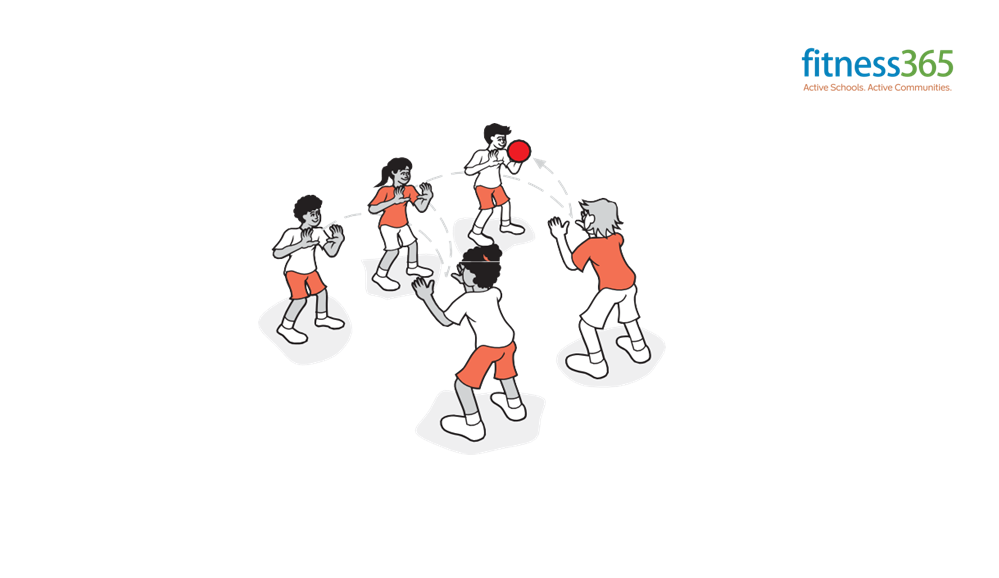
In a circle of five–six with two balls
- throw/pass a ball around the circle, then reverse the direction on a signal
- throw/pass two balls in the same direction – play Dog and Rabbit: can one ball catch the other?
- throw/pass to anyone – one ball than two balls
- throw/pass to every second person
- face outwards and pass back overhead
- pass to anyone except an adjacent player. How many passes can you make in 30 seconds?
- surround a leader in the center, who throws/passes to each player in turn, to anyone, passes a ball out as the other is passed in (In and Out)
Activity 2: Zigzag
Groups of five or six in two lines facing each other.
- pass a ball and zigzag up and down
- pass it up one line and pass it down the other line
- pass one ball, then, when it reaches the end, pass the next, then the next, etc
- pass one ball, then the next, then the next, etc
- pass one ball as many times as possible… seconds
- using two balls, throw to anyone on the other line who doesn’t have a ball
Variations
Vary skill: Use a push pass (soccer, hockey), chest pass, two-handed overhead pass.
Vary equipment: Use different balls, (e.g. rugby ball for a spiral pass).
Vary distance: Increase or decrease the distance required for the pass.